
South Asia, From the Ground
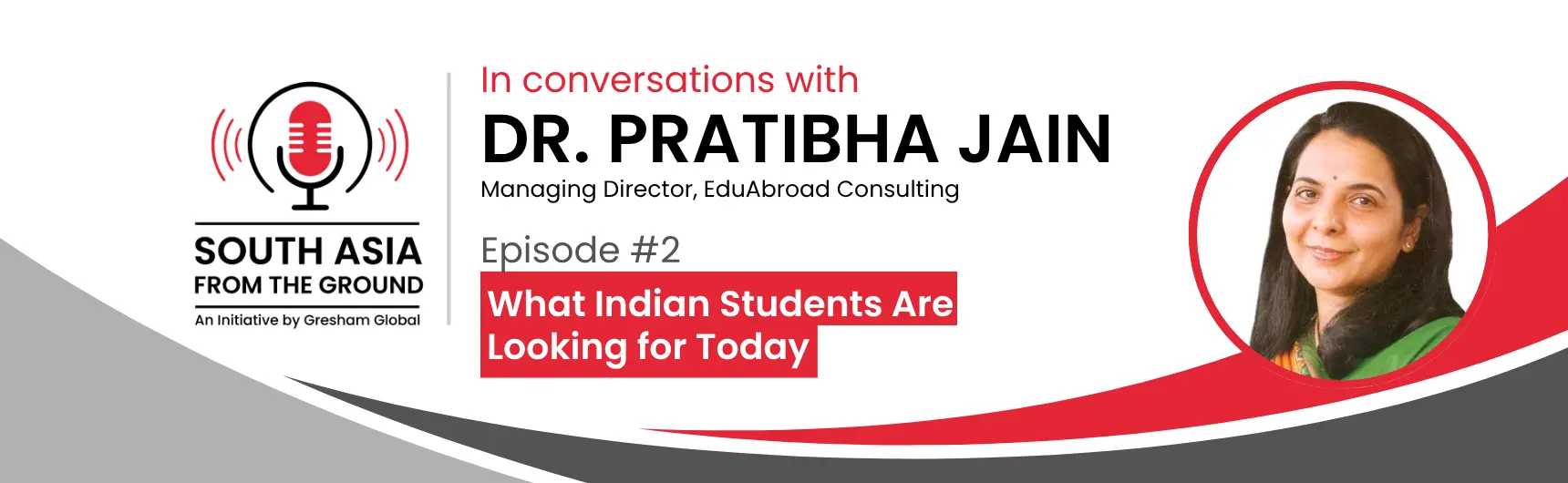
A conversation with Dr. Pratibha Jain, Managing Director, EduAbroad ConsultingAbout South Asia, From the Ground
South Asia, From the Ground is a conversation-led platform built on the insights, experiences, and perspectives of industry leaders across South Asia, bringing on-ground voices to the forefront of global education discussions.
India's study abroad landscape is changing. The traditional preference for medicine and engineering is giving way to a much broader range of career possibilities, while employability, outcomes, skills and return on investment are becoming increasingly important to students and families.
In the second edition of South Asia, From the Ground, we speak with Dr. Pratibha Jain, Managing Director of Edu Abroad, who brings more than three decades of experience in international education. From changing student aspirations and parental expectations to the growing importance of industry-academia partnerships, she shares her perspective on what is shaping India's next generation of international students and what universities need to do to remain relevant.
From Prestige to Purpose
For years, university reputation and global rankings played a significant role in how Indian families evaluated international education.
Today, the conversation is becoming more nuanced.
Students and parents are asking whether a university is the right career fit, whether the curriculum is contemporary, what opportunities exist beyond the classroom, and how the education will contribute to their long-term outcomes.
Dr. Jain believes this shift reflects a broader change in how students think about their futures. They are no longer necessarily choosing between passion and profession. Instead, they increasingly expect the two to coexist.
Students are becoming more willing to explore different interests and build careers around multiple talents rather than fitting themselves into a single predefined path.
The Student Has a Voice
Perhaps one of the biggest changes Dr. Jain has witnessed is the growing confidence of Indian students.
Earlier, university decisions were often driven predominantly by parents. Today, students are far more vocal about what they want, more willing to question conventional choices and increasingly prepared to put in the work required to pursue their interests.
This independence is also changing how students approach university.
Rather than simply asking, "Which university is best?", they are asking whether a particular institution, course and environment are right for them.
That shift is particularly important for undergraduate education.
Dr. Jain points to a growing need for universities to give students room to explore before expecting them to commit to a narrow academic pathway.
The traditional model of "first decide, then learn" is increasingly giving way to "first learn, explore, then decide."
The Rise of Career-Driven Choices
The growing emphasis on careers does not necessarily mean that students are becoming less interested in diverse or unconventional subjects.
In fact, Dr. Jain is seeing the opposite.
Agriculture science, drone technology, design, hospitality, psychology, sports and creative disciplines are attracting increasing interest. Psychology, which was once considered a relatively limited field, now intersects with business, marketing, education, design and technology.
Hospitality is also evolving beyond the traditional hotel industry, with opportunities emerging across wellness, wildlife, religious and medical tourism.
The creative industries are similarly expanding, encompassing media, communication, advertising, music, performing arts and filmmaking, with digital and OTT platforms opening new possibilities.
The message is not that traditional disciplines will disappear. Rather, students are beginning to see a wider spectrum of careers as commercially viable and professionally meaningful.
ROI Is Becoming Part of the University Conversation
For today's Indian families, international education is increasingly viewed as a significant financial investment.
Parents are asking harder questions about employability, outcomes and what their child will gain from the experience.
Dr. Jain believes universities need to respond with greater transparency, particularly around graduate outcomes.
One question she repeatedly asks universities is whether their published employment statistics include international students.
For counsellors and families making high-value decisions, this distinction matters.
At the same time, she argues that outcomes need to be defined more broadly than salary alone.
The value of international education can include exposure, perspective, skills, learning, independence and the ability to approach problems differently.
The challenge for universities is therefore not simply to demonstrate ROI, but to clearly define what that return actually means.
Rethinking the Student Experience
The traditional idea of student experience often focuses on campuses, facilities, sports infrastructure and lifestyle.
But for today's students, experience increasingly means learning that connects with the real world.
Industry projects, research, co-ops, practical learning and partnerships between academia and industry are becoming important differentiators.
According to Dr. Jain, universities are generally teaching from access to the same academic resources. What can truly differentiate an institution is how effectively it connects that knowledge to contemporary problems and the world of work.
This is where industry-academia collaboration becomes critical.
AI Is Changing the Counsellor's Role, Too
Students are arriving better informed than ever.
They are using AI tools such as ChatGPT to research universities, courses and destinations before speaking to a counsellor.
Dr. Jain does not see this as something the industry should resist.
Instead, she sees it as a reason for counsellors to strengthen their own expertise.
Students may come armed with AI-generated information, but they still need someone who can add context, challenge assumptions and understand the individual behind the data.
The role is moving from simply providing information to helping students combine research with experience and judgement to build a realistic pathway.
The Future Is More Global and More Collaborative
India's outbound student mobility is not slowing down, but the destinations students consider are changing.
The decision-making landscape is expanding beyond the traditional focus on a small number of countries, with students increasingly exploring destinations across Europe, Asia-Pacific and beyond.
At the same time, Dr. Jain is seeing another important development: students from international markets showing interest in studying in India.
This could signal a future of greater collaboration between Indian and international institutions, including semester exchanges, partnerships and two-way student mobility.
The relationship between India and the global higher education ecosystem may therefore become less about one-way outbound mobility and more about shared learning and collaboration.
What Universities Need to Do Next
For international universities looking to attract students from India, Dr. Jain's advice is clear: move beyond simply communicating reputation.
Universities need to demonstrate what makes their curriculum different, what outcomes students can expect, how the learning experience translates into professional development, and what diversity and international exposure genuinely add to the student journey.
Most importantly, she believes universities need to strengthen their connections with industry.
Because, as she puts it:
"The future belongs to universities that have industry-academic partnerships."
For a market where students are becoming more independent, parents more financially conscious and career choices more diverse, the institutions that remain relevant will be those willing to evolve alongside them.
About Dr. Pratibha Jain
Dr. Pratibha Jain is the Founder & CEO of Edu Abroad, with more than three decades of experience in international education. Through her work with students, parents and universities, she has witnessed the evolution of India's study abroad landscape firsthand, from traditional university choices driven largely by rankings and parental influence to a more exploratory, career-conscious and globally connected generation of students.
Her perspective is shaped by years of counselling, engaging with universities and observing how student aspirations, employability expectations and the international education landscape continue to evolve.